Korean Corn Dogs: How a Street-Stall Snack Became America's Favorite K-Food Import
By Logan · Published 2026-09-07
Why are Korean corn dogs everywhere now? The full story — from 1970s train-station stalls to the mozzarella cheese pull, the potato "ugly dog," and the chains taking over US malls — plus how to make all four styles at home.
Why Everyone Is Talking About It
Of every Korean food that's crossed the Pacific in the past decade, none has planted its flag in American malls quite like the Korean corn dog. What started with hour-long lines outside a handful of New York and LA shops in 2021 has quietly become infrastructure: chains like Two Hands and Myungrang have reportedly grown to hundreds of US locations opened or in development — increasingly not in Koreatowns but in suburban food courts across Arkansas, Kansas, Texas, and Missouri. North Carolina's state fair reportedly added one to its lineup. The trend didn't fade; it settled in.
And unlike most of the trends this series covers, this one is fully makeable at home — the batter is simple, the fillings are flexible, and the signature crunch comes from things already in your pantry. Here's how a Korean reinvention of an American fairground snack completed the round trip, and the four styles worth frying yourself.
Where It All Started
The Korean corn dog begins, fittingly, with the American one. The snack is believed to have arrived with American soldiers during the Korean War era — the same cultural exchange that eventually produced Korean fried chicken and budae jjigae. By the mid-1970s it had become a street-food fixture, but with a very Korean twist born of necessity: meat was scarce and expensive in 1970s Korea, so early versions were often battered fish-paste sausages — a derivative of Japanese-style fishcake — rather than pork franks. Through the 1980s they spread through train stations and bus terminals as cheap, hot, portable food, and Koreans simply called them hot dogs (핫도그) — a naming quirk that confuses English speakers to this day. In Korea, a "hot dog" is on a stick.
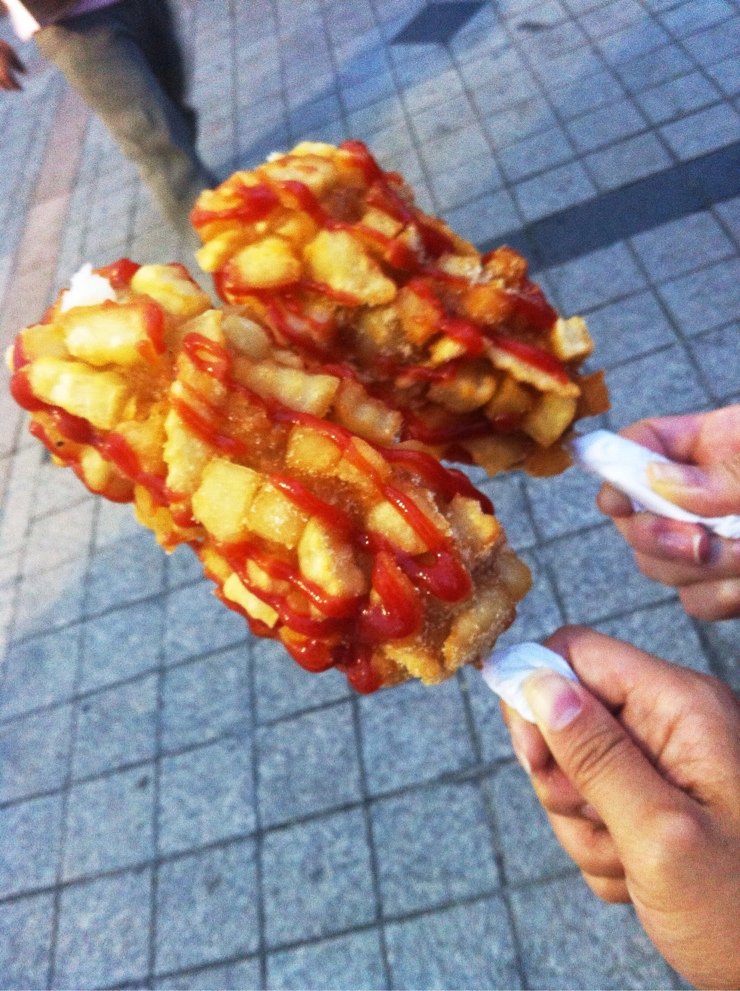
Along the way, Korean vendors quietly re-engineered the thing. Out went the dense cornmeal batter; in came lighter yeast- and rice-flour batters that fry up crisp outside and chewy inside — the same geot-ba-sok-jjon texture ideal that runs through this whole series. On went coatings: panko for shatter, cubed potatoes for the famously lumpy gamja (potato) dog — affectionately nicknamed motnani, the "ugly one" — and eventually crushed ramen noodles for maximum crunch. And in went the game-changer: mozzarella, replacing some or all of the sausage, which turned a fairground snack into cheese-pull content a decade before anyone knew what that would mean.
Why It Blew Up
The modern wave has a specific origin point: Myungrang Hot Dog, a stall that started in Busan and turned the humble street snack into a franchise phenomenon — reportedly expanding to around 650 Korean locations within three years on the strength of its crackly rice-batter dogs and creative coatings. In 2018 Myungrang crossed to the US, and when its LA Koreatown shop opened the following year, demand reportedly forced a five-corn-dogs-per-person limit.
Then 2021 happened. With Korean culture cresting in the US — K-pop, K-dramas, and a pandemic generation discovering food through TikTok — the Korean corn dog became one of the most photographed snacks of that summer. Two Hands opened its first New York location that April and had reportedly reached fifteen US locations by September with dozens more in development; media from Time Out to NBC covered the hour-long lines. The camera-readiness did heavy lifting: the slow-motion cheese pull, the sugar dusting, the rainbow of sauces — few foods hand a phone camera that much to work with.
But the more interesting part of the story is what happened after the lines died down. Instead of receding with the hype cycle, the category kept growing outward — from coastal cities into the American heartland, from Koreatown storefronts into suburban malls and state fairs. NBC's assessment captured it: the Korean corn dog stopped being a trend and became a fixture. In this series full of 13-day trend half-lives, that's the rarest outcome there is.
My read on the staying power: the product filled a genuine gap. American food courts had pizza, pretzels, and cinnamon rolls; what they didn't have was a hot, handheld, under-$8 item engineered for the phone-out generation. The Korean corn dog slid into that slot almost perfectly — familiar enough (it's a corn dog) to need no explanation, different enough (the chew, the cheese, the sugar) to be worth a post. Food-service trade press now openly recommends the category to American operators, which is about as "the trend is over, the business remains" as it gets.
How It Keeps Evolving
The format keeps mutating on both sides of the Pacific. In the US, menus lean into Americana-meets-Seoul: Hot Cheetos coatings, injeolmi-powder dogs, half-mozzarella-half-cheddar builds, and dessert-adjacent versions dusted like doughnuts. Mochi-doughnut chains sell corn dogs; corn dog chains sell mochi doughnuts; the Korean-snack food court has become its own genre. In Korea, the corn dog long ago folded into the broader street-food canon alongside tteokbokki and sotteok-sotteok — and the "put mozzarella in it, roll it in something crunchy, finish with sugar" formula keeps getting applied to new hosts.
Two practical notes from my own frying adventures before we get to the recipes. First, the sugar: newcomers always hesitate at rolling a savory, cheesy, fried thing in granulated sugar. Don't skip it — the sweet-salty contrast is the entire Korean corn dog experience, and it's the single most common thing American versions get wrong by omission. Second, the cheese: low-moisture mozzarella sticks, frozen for 20 minutes before battering, are the difference between a clean cheese pull and a burst dog leaking into your oil. Every failed Korean corn dog I've made traces back to warm cheese.
If you'd rather eat one than fry one, you're covered too — beyond the big chains, Korean corn dogs have reached grocery freezers, and most H Marts sell frozen versions that air-fry respectably. But the homemade one, eaten two minutes out of the oil, is a different food entirely. We already keep full step-by-step recipes for the two core styles on this site — the classic and the potato dog — so the minis below are the four-style overview plus the batter that makes them all work.
Try It at Home
Some links below are affiliate links. As an Amazon Associate I earn from qualifying purchases. Learn more
1. The Base Batter (One Batter, Every Dog)
The chewy-crisp Korean batter that separates these from American corn dogs — no cornmeal, just a lightly sweetened yeast-and-rice-flour dough that fries into a stretchy crumb.
Ingredients
- 200g all-purpose flour + 50g rice flour
- 1 tbsp sugar, 1 tsp instant yeast, 1/2 tsp salt
- 180-200ml warm milk (or water)
- 1 egg
- Panko, for rolling (about 2 cups)
Steps
- Whisk everything except panko into a thick, sticky, stretchy batter — thicker than pancake batter; it should reluctantly drop off a spoon.
- Rest 40-60 minutes until puffy. The yeast rest is what gives the chew — don't skip it.
- Dry your skewered filling well, dredge lightly in flour, then coat in batter by rotating the stick with one hand and guiding the batter with a spatula (or a tall glass of batter).
- Roll immediately in panko (or the coatings below) and fry at 170°C (340°F) for 4-6 minutes until deep golden.
- Sugar first, sauce second — always in that order, while hot.
The setup that makes frying painless
- Bamboo skewers (thick)(paid link) — flat or thick round ones hold heavy dogs better
- Low-moisture mozzarella sticks(paid link) — string cheese works perfectly — freeze 20 min first
2. Classic Mozzarella Dog
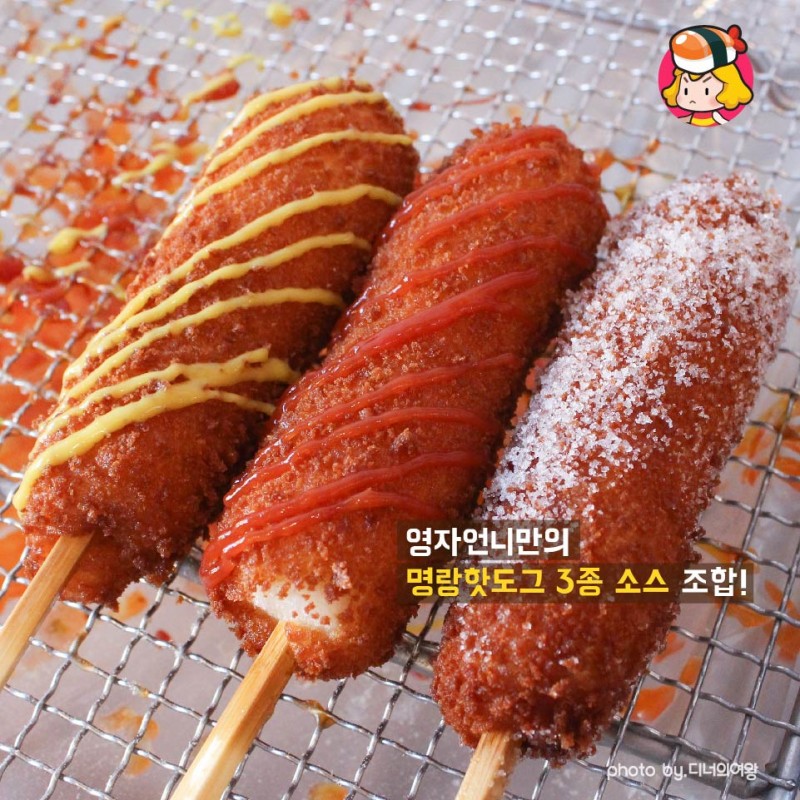
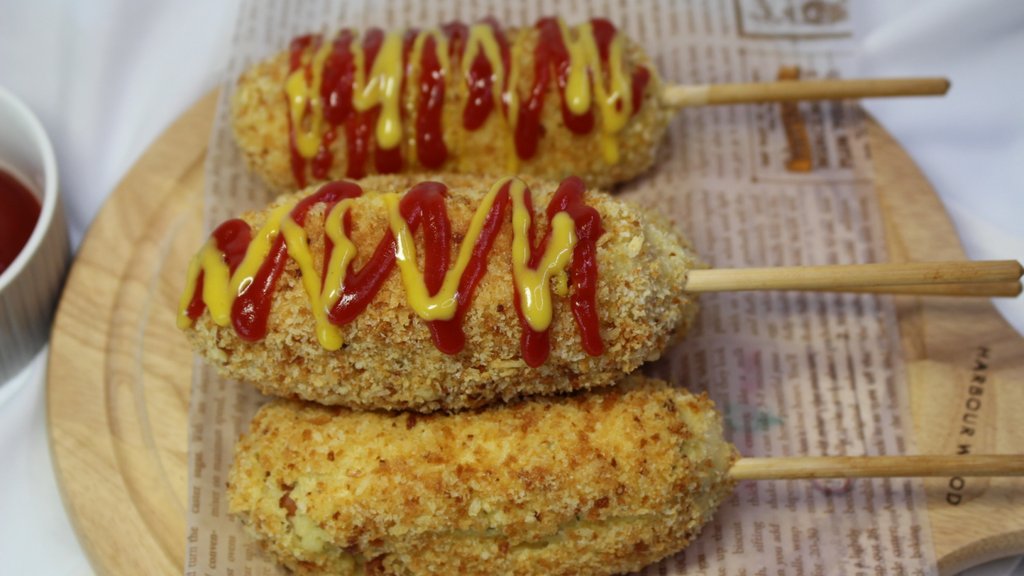
The definitive version: half sausage, half mozzarella (or go full cheese), panko crust, sugar dusting. Our full korean-corn-dogs recipe covers this in detail — this is the short version.
Ingredients
- Hot dogs and mozzarella sticks, cut to half-lengths
- Base batter + panko
- Sugar, ketchup, and yellow mustard to finish
Steps
- Skewer a half sausage then a half mozzarella stick (cheese toward the top — it insulates better).
- Batter, panko, fry until deep golden.
- Roll in sugar while hot, then stripe with ketchup and mustard.
- Photograph the pull fast; mozzarella waits for no one.
3. Gamja Dog (the "Ugly" Potato Dog)
The cult favorite — cubed potatoes fried onto the outside, creating the gloriously lumpy surface Koreans nicknamed motnani, "the ugly one." Ugly is the point. Our potato-corn-dog recipe has the full method.
Ingredients
- Base batter setup (above)
- 2 waxy potatoes, cut in 1cm cubes, soaked, and thoroughly dried
- Optional: half-and-half potato + panko for structure
Steps
- Press the battered dog gently into the potato cubes, patching bare spots by hand — they will look wrong; that's right.
- Fry slightly cooler (165°C) and slightly longer, 6-7 minutes, so the potato cooks through as it crisps.
- The result eats like a corn dog wrapped in tiny french fries, which is exactly as good as it sounds.
4. Ramen-Crusted Dog
The crunch-maximalist build: crushed instant ramen as the coating, a Korean street-stall trick that came home to America through the trend. Use any brick ramen — including the leftover half of a Buldak pack, which brings this series full circle.
Ingredients
- Base batter setup
- 1 brick instant ramen, crushed to pea-size pieces (save the seasoning packet)
- Pinch of the seasoning packet mixed into the crumbs (optional, adds savor)
Steps
- Crush the ramen inside its bag with a rolling pin — pea-size, not powder; powder burns.
- Batter the dog, roll firmly in the ramen crumbs, and press to embed.
- Fry at 165°C for 4-5 minutes — ramen browns faster than panko, so pull at deep amber, not brown.
- Sugar-dust while hot. Trust the process.
Crunch donors
- Instant ramen bricks(paid link) — any brand — the noodle, not the cup